
Blogs
Albino Burmese Python: Facts, Size, Diet and Lifespan

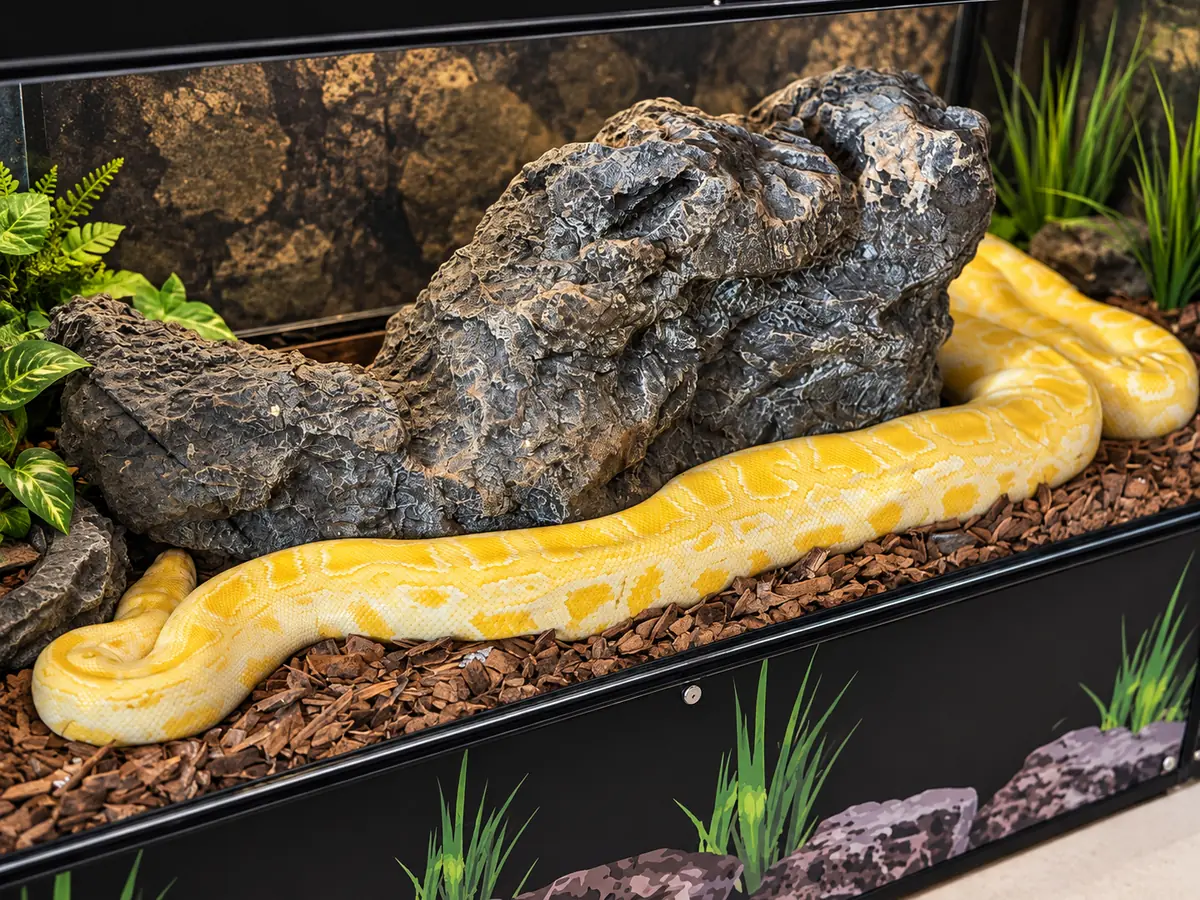
Golden yellow patches on a creamy white body make the albino Burmese python one of the most striking snakes in any showroom. It is a colour form of the Burmese python (Python bivittatus), one of the largest snakes in the world. Here are the essentials.
Quick facts
| Scientific name | Python bivittatus (Burmese python) |
|---|---|
| Origin | Southeast Asia |
| Habitat | Grassland, marshes, swamps and forest near water |
| Adult size | Commonly 3 to 4.5 m, and some grow longer |
| Lifespan | 20 to 30 years in captivity |
| Diet | Mammals and birds |
| Activity | Mostly active at night and at dusk |
| Venom | None. It is a constrictor. |
What makes an albino Burmese python special?
A wild Burmese python is brown with darker blotches. An albino has an inherited trait that removes the dark pigment, which leaves a snake with yellow and white colouring and pale pink or red eyes. This colour form is bred in captivity, because a snake this bright would be easy for predators to spot in the wild.
Where do Burmese pythons come from?
Burmese pythons are native to Southeast Asia. They live in grassland, marshes and forest, usually near water, and they are strong swimmers. Wild Burmese pythons are listed as Vulnerable by the IUCN.
How big do they grow?
Burmese pythons are among the largest snakes on Earth. Adults commonly reach 3 to 4.5 m, and the heaviest weigh dozens of kilograms. Young snakes grow quickly in their first years. With good care they can live 20 to 30 years in captivity.
What do Burmese pythons eat?
Burmese pythons are constrictors. They ambush their prey, wrap their coils around it and squeeze. In the wild they eat mammals and birds. Their flexible jaws let them swallow prey much wider than their head, and they may then go for days or weeks without eating again.
A day in the life
Burmese pythons are mostly active at night and at dusk. By day they rest in cover or in the water. Young pythons climb well, while heavy adults spend most of their time on the ground and in the water.
Did you know?
Pythons have heat-sensing pits along their lips, which let them detect the body heat of warm-blooded prey in the dark. A female Burmese python also coils around her eggs and shivers her muscles to keep them warm. Escaped pet Burmese pythons have even built up wild populations in Florida’s Everglades, which is why releasing exotic pets is harmful.
In captivity
A Burmese python is a long-term commitment and not a beginner’s snake. It needs a very large, strong enclosure with a warm side (about 31 to 33 °C) and a cooler side (about 26 to 28 °C), clean water large enough to soak in, and appropriately sized prey. A large adult should never be handled alone. Keeping large snakes is restricted in many countries, so check local rules and use only captive-bred animals from licensed sellers.