
Blogs
Macaws: Blue-and-Yellow and Green-Winged Macaw Facts

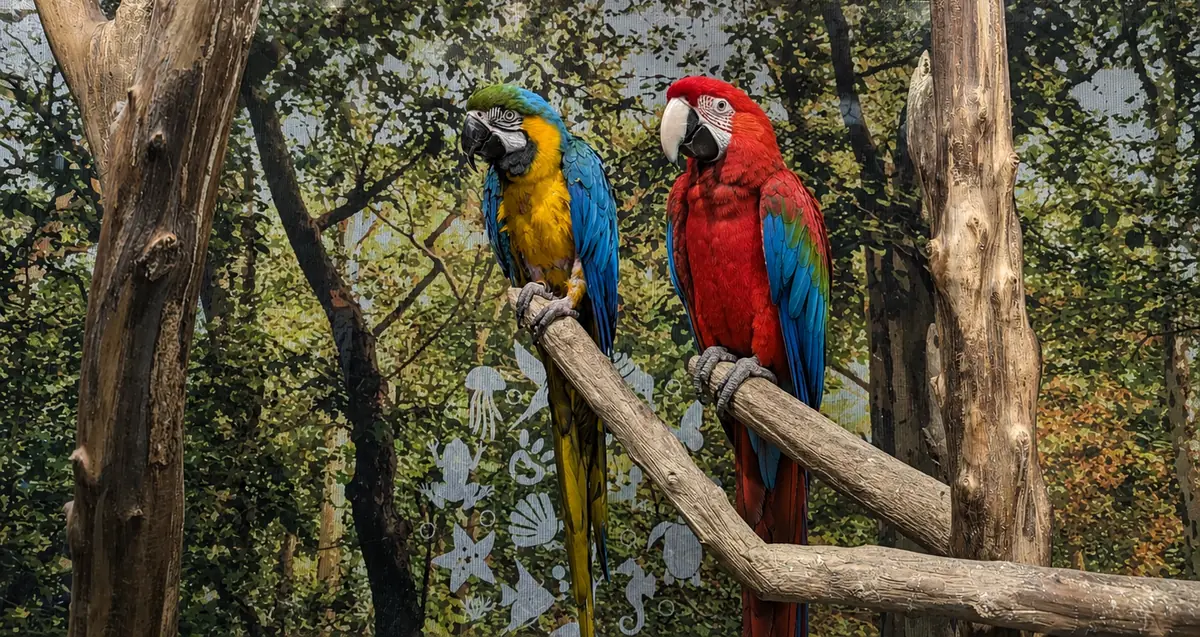
With brilliant feathers, enormous curved beaks and tails nearly as long as their bodies, macaws are among the most spectacular parrots in the world. The two birds shown here belong to two different species: the blue-and-yellow macaw and the green-winged macaw. Both come from the forests of South America. Here are the essentials.
Quick facts
| Blue-and-yellow macaw | Green-winged macaw | |
|---|---|---|
| Scientific name | Ara ararauna | Ara chloropterus |
| Origin | Northern and central South America | Northern and central South America |
| Habitat | Tropical forest, swamp forest and wooded savanna | Tropical rainforest |
| Length | About 80 to 90 cm | About 90 to 95 cm |
| Weight | About 0.9 to 1.3 kg | About 1.0 to 1.7 kg |
| Colours | Blue back and wings, yellow chest, green forehead | Red body, blue and green wings, white face with fine red lines |
| Diet | Seeds, nuts, fruit and flowers | Seeds, nuts, fruit and flowers |
| Lifespan | Often 50 years or more in captivity | Often 50 years or more in captivity |
What is a macaw?
Macaws are large, long-tailed parrots from Central and South America. Their long tail feathers help them steer through the forest, and their strong, curved beaks can crack hard nuts. Like other parrots, they have two toes pointing forward and two pointing back, which lets them grip branches firmly and hold food in one foot.
How can you tell the two apart?
The blue-and-yellow macaw has a bright yellow chest and belly, blue wings and back, a green forehead and a white face with thin black lines. The green-winged macaw is mostly deep red, with a band of green across its blue wings and a white face marked with lines of tiny red feathers. It is one of the heaviest macaws.
Where do macaws live?
Both species live in the tropical forests of northern and central South America. They nest in tree hollows and spend the day moving between feeding trees, often flying long distances in pairs or small groups.
What do macaws eat?
Macaws eat seeds, nuts, fruit and flowers. In some regions they gather at riverbank clay licks to eat clay. Scientists think this may help them deal with natural toxins in some of the seeds they eat.
A day in the life
Macaws are active by day. They fly out at dawn to feed, rest during the hottest hours, and return to roost in tall trees in the evening. Their loud calls carry far through the forest, which helps pairs and flocks stay in contact.
Family life
Macaws form strong, long-term bonds with their partners and are often seen flying side by side. Pairs usually raise a small number of chicks at a time in a tree hollow, and both parents help to feed them.
Did you know?
A macaw’s bare white face is not just skin. It can turn pink when the bird is excited or alert, almost like blushing. Macaws are also very intelligent, and some can copy human speech.
In captivity
Macaws can live for many decades, so keeping one is a very long commitment. They are loud, need a lot of space to fly and climb, and need daily social contact and things to chew. International trade in macaws is regulated, so check local rules and use only captive-bred birds with proper documents from licensed sellers.